Set-Piece Specialists Become 2026 World Cup Knockout Swing Factors
For decades, set pieces were treated as football's afterthought—a few minutes of drill before full training, then left to whichever player fancied the delivery. That era is over. At the 2026 World Cup, every serious contender will arrive with a dedicated set-piece coach, a library of coded routines, and scouting reports that grade opponents' defensive vulnerability from A to C. In a knockout tournament where single-goal margins decide roughly half of all matches, the work of these specialists could be the difference between a quarterfinal exit and a semifinal run.
Set-piece coaches shift from backroom to spotlight
The transformation has been gradual but unmistakable. England's 2018 campaign is often cited as the watershed: seven of their twelve goals in Russia came from set pieces, including all three in the quarterfinal against Sweden. Gareth Southgate's staff had spent months refining routines, and the payoff was a semifinal appearance—England's best in 28 years. Denmark, at the 2021 European Championship, scored 40% of their goals from dead balls, a figure that helped them reach the semifinals. By the 2022 World Cup, dedicated set-piece analysts were standard on nearly every staff, and the trend has only accelerated.
The rise of the set-piece coach mirrors a broader professionalization of football's margins. Where once a manager might sketch a corner routine on a whiteboard, today's specialists build databases of opponents' defensive tendencies, track goalkeeper starting positions, and rehearse variations for every free-kick zone on the pitch. Italy's Gianni Vio is the most famous example: his work with the national team produced 17 set-piece goals between 2018 and 2022, a figure that helped Italy win the 2021 European Championship. Now federations from Belgium to Japan have hired their own Vio-inspired analysts.
Yet the shift is not without sceptics. Some traditionalists argue that over-reliance on set pieces can stifle attacking fluidity, and that the best teams create chances from open play. But the numbers are hard to ignore. In a sport where margins are razor-thin, leaving a potential advantage unexploited is increasingly seen as negligence.
Data reveals set-piece efficiency gap between knockout regulars and outsiders
The statistical case for set-piece investment is compelling. Across the 2018 and 2022 World Cups, roughly 35% of all knockout-stage goals originated from set pieces—including corners, free kicks, and throw-ins. Among the top 10 FIFA-ranked teams as of late 2024, average set-piece expected goals (xG) per match stands at around 0.45, compared to roughly 0.28 for teams ranked outside the top 20. That gap of about 0.17 xG per game may seem small, but over a seven-match tournament, it translates to more than one extra set-piece goal—potentially decisive in a knockout bracket.
The disparity reflects both technical quality and preparation. Elite teams tend to have taller players, better delivery, and more rehearsed routines. But the gap is not insurmountable. Smaller federations have shown that smart design can compensate for physical disadvantages. Japan, at the 2022 World Cup, scored two goals from rehearsed corners—one against Germany and one against Spain—both of which were critical to topping their group. Morocco, a semifinalist that year, also relied on set-piece efficiency, scoring four goals from dead-ball situations across the tournament.
Outsiders who neglect set pieces, however, risk falling further behind. As the 2026 tournament expands to 48 teams, more debutants will face knockout regulars with years of dedicated set-piece work. The efficiency gap is already visible in qualifying: teams that invest in specialist coaches tend to concede fewer set-piece goals and score more. Some estimates suggest that a well-drilled set-piece unit can improve a team's goal difference by three to four over a qualifying campaign—a margin that can separate automatic qualification from the play-offs.
Specialist routines target specific defensive weaknesses
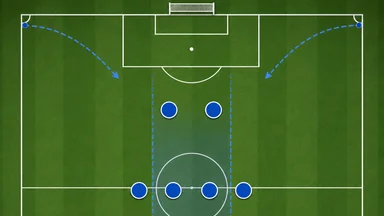
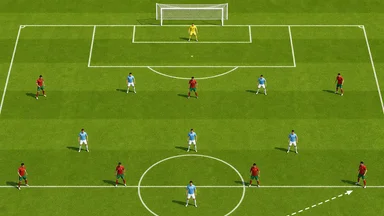
Modern set-piece design is data-driven and opponent-specific. Coaches watch 200 or more clips of an opponent's defensive setups, looking for patterns: which defender is weakest in the air, which zonal marker drifts, where the goalkeeper tends to start. From that analysis, they design routines that exploit those weaknesses. Near-post flicks, for example, are often used against teams that employ zonal marking, because the zone near the post is typically unoccupied. Short corners force defenders to shift laterally, creating space for overloads at the far post.
The choice between inswinging and outswinging deliveries is informed by the goalkeeper's starting position. If the goalkeeper tends to start near the center of the goal, an outswinging corner that bends away from goal can be difficult to attack. If the goalkeeper starts deep, an inswinging delivery aimed at the six-yard box can cause panic. These are not generic preferences; they are tactical decisions based on hours of video review.
One of the more sophisticated developments is the use of "blocking" or "pick" movements—similar to basketball screens—to free up a designated header. These are often rehearsed to the point of choreography, with triggers such as a specific defender stepping forward or raising an arm. The 2022 World Cup saw several goals from such routines, including Argentina's second goal in the final, which originated from a well-worked corner routine that created space for Ángel Di María's finish. Though Di María's goal was from open play, the movement pattern was a direct carryover from set-piece training.
Critics note that such routines can be neutralized if opponents study them in advance. But the best coaches build in variations: the same starting formation can produce three or four different outcomes depending on the trigger. This makes it difficult for defenders to anticipate, especially under the pressure of a knockout match.
Gianni Vio model inspires replication across federations
Gianni Vio's influence on international football is difficult to overstate. The 67-year-old Italian, who previously worked with AC Milan and Tottenham, joined the Italy national team in 2018 and immediately transformed their dead-ball output. Under his guidance, Italy scored 17 set-piece goals between 2018 and 2022—more than any other European team in that period. His methods, which emphasize repetition, variation, and detailed scouting, have been widely studied and adopted.
Belgium, a team that has historically underperformed in knockout tournaments, hired a dedicated set-piece coach in 2023, following Vio's model. The United States, which co-hosts the 2026 tournament, has also invested in a set-piece specialist, recognizing that home advantage may be offset by a lack of knockout experience. Japan, already a set-piece success story from 2022, has deepened its commitment, with the Japan Football Association funding a full-time analyst focused solely on dead balls.
The Vio model is not a magic formula, however. It requires buy-in from players and coaches, and it demands significant training time. Some federations have struggled to implement it because their domestic leagues do not prioritize set-piece coaching, leaving players unfamiliar with complex routines. There is also the risk of over-specialization: if a team becomes too predictable from set pieces, opponents can adapt. The best practitioners, like Vio, constantly evolve their repertoire.
Knockout scenarios amplify set-piece payoff
Knockout matches at World Cups are famously tight. Since 1998, roughly half of all knockout games have been decided by a single goal, and many of those goals have come from set pieces. At the 2022 World Cup, four of the eight knockout matches featured a set-piece goal that either broke a deadlock or proved decisive. In extra time, when fatigue sets in and defensive concentration wanes, set pieces become even more potent. Players who have rehearsed a routine hundreds of times can execute it almost automatically, while defenders are more likely to lose their marks.
Penalty shootouts, too, are influenced by set-piece confidence. Players who regularly take corners or free kicks tend to be more comfortable striking the ball cleanly, and the repetitive nature of set-piece practice builds a mental routine that transfers to spot kicks. Some teams explicitly use set-piece drills as part of their penalty preparation, emphasizing the same technical cues.
The expanded 48-team format for 2026 means more knockout rounds and more opportunities for set-piece moments. Teams that advance from group play may face opponents with less rest, amplifying the advantage of rehearsed routines. The margin for error in a single-elimination match is already slim; adding a set-piece specialist to the staff is a relatively low-cost way to tilt the odds.
Training load and repetition separate elite set-piece teams
Elite set-piece teams treat dead balls as a separate discipline, devoting 45 minutes or more each day to practice. This includes not only delivery and finishing, but also defensive organization, transition patterns, and rehearsed variations. Routines are often coded by trigger: a specific movement by a defender, a hand signal from the kicker, or a pre-arranged count. Players are assigned specific targets—near post, penalty spot, far post—and delivery is tailored to each target's strengths.
Repetition builds muscle memory, but it also builds trust. When a player knows exactly where a teammate will run, they can deliver the ball with confidence. This is especially important for indirect free kicks, where the first touch can be as important as the shot. Some teams have been known to practice the same routine hundreds of times over a tournament cycle, adjusting only the final pass or finish.
The downside of heavy set-piece training is that it takes time away from open-play work. Managers must balance the two, and some argue that the marginal benefit of an extra 15 minutes of set-piece practice is lower than an equivalent amount of pressing or possession work. But for knockout tournaments, where set pieces account for a disproportionate share of goals, the trade-off often favors the specialist. The best teams find a middle ground: integrating set-piece principles into open-play drills so that players internalize both.
Scouting reports now include set-piece vulnerability grades
As set-piece coaching has become more sophisticated, so has scouting. Many national teams now grade opponents on their set-piece defensive vulnerability, using a simple A-to-C scale. A Grade A team is strong in the air, well-organized, and has a goalkeeper who commands the box. Grade C teams have poor marking, a short or indecisive goalkeeper, or a tendency to switch off on second balls. Match plans are adjusted accordingly: against a Grade C team, a side might prioritize corners and free kicks in dangerous areas; against a Grade A team, they might focus on short corners or quick restarts to catch defenders out of position.
The grading is not static; it evolves as teams change personnel or tactics. A team that was Grade A in the group stage might slip to Grade B if a key defender is injured or suspended. Knockout ties can hinge on these mismatches. At the 2022 World Cup, Morocco exploited Croatia's Grade C vulnerability on corners in the semifinal, though they failed to convert. The trend is clear: teams that invest in set-piece scouting gain an edge that can be decisive in tight matches.
Yet grading systems have limitations. They rely on past data, and a clever coach can design a routine that exploits a specific weakness even against a Grade A defense. The best set-piece coaches are not just analysts; they are creative problem-solvers who find angles that the data alone might not reveal. As the 2026 World Cup approaches, the arms race in set-piece innovation shows no signs of slowing. The question is not whether set pieces matter—they do—but which team will execute best when it counts.
Counter-arguments and trade-offs in set-piece specialization
Despite the growing emphasis, some analysts question whether the trend has been overstated. They point out that set-piece conversion rates have remained relatively stable over the past decade, hovering around 3–4% of corners leading to goals. The increase in total set-piece goals, they argue, is partly due to more dead-ball opportunities arising from changes in defensive tactics, not necessarily better coaching. Additionally, the variance in set-piece success from tournament to tournament is high: a team that scores heavily from set pieces in one edition may regress in the next simply due to luck or opponent adjustments.
Another trade-off involves player development. Young players who spend excessive time on rehearsed routines may neglect fundamental skills like dribbling, passing, and decision-making in open play. Some academies have resisted the trend, fearing that over-specialization could produce one-dimensional footballers. However, proponents counter that set-piece proficiency is a skill like any other, and that modern players must be versatile enough to contribute in all phases of the game.
Financial considerations also play a role. Hiring a dedicated set-piece coach adds to the staff budget, which may be prohibitive for smaller federations. The return on investment is not guaranteed, and some national associations prefer to allocate resources to grassroots development or sports science. Yet the growing number of federations willing to invest suggests that the perceived benefits outweigh the costs for those with knockout aspirations.
In the end, the set-piece arms race is a microcosm of football's broader evolution: every marginal gain is pursued relentlessly, and those who ignore it do so at their peril. The 2026 World Cup will provide the ultimate test of whether this specialization pays off, but the evidence so far points strongly in its favor.