Goncalo Inacio Left-Foot Build-Up Reshapes Portugal 2026 Central Defense
When Portugal's squad for the 2026 World Cup is announced, most eyes will be on Bruno Fernandes, Rafael Leao, or the aging Cristiano Ronaldo. But the most quietly transformative selection might be a 24-year-old left-footed center-back who has spent his entire career at Sporting Lisbon. Goncalo Inacio is not a household name beyond the Primeira Liga, yet his profile addresses a structural weakness that has nagged Portugal for years: the absence of a natural left-sided defender who can build play with his stronger foot. With Pepe retired and Rúben Dias anchoring the right side, Inacio's inclusion could reshape how Portugal progresses the ball—and potentially create more varied attacking patterns.
Why Portugal's defensive shape needs a left-footed solution
For much of the past decade, Portugal's central defensive pairings have been dominated by right-footers. Rúben Dias, now at Manchester City, is arguably the best in the world but is exclusively right-footed. Antonio Silva, his likely long-term partner, is also right-footed. Danilo Pereira, used as a makeshift center-back at times, is right-footed as well. Pepe, though nominally right-footed, operated comfortably on the left side due to his experience and ambidexterity, but his retirement after Euro 2024 leaves a void.
The imbalance matters because a left-footed center-back naturally opens passing angles that a right-footer cannot replicate without twisting his body. When a right-footed defender plays on the left side of a back two or three, he tends to receive the ball on his weaker foot or must turn onto his right, delaying distribution and inviting pressure. This asymmetry has cost Portugal in tight matches—against Belgium in the 2021 Euros, for instance, or in the 2022 World Cup quarterfinal against Morocco, where build-up play stagnated. In the Morocco match, Portugal's 0-1 loss was marked by an inability to break through a compact defense; a left-footed center-back might have provided the diagonal passes needed to stretch the Moroccan block.
Left-footed center-backs are rare in elite football. According to data from Transfermarkt (footnoted), fewer than 15% of top-division center-backs across Europe's big five leagues are left-footed. Portugal's national team pool is even thinner. Aside from Inacio, the only left-footed options with senior caps are Goncalo Cardoso (on loan at Betis) and the uncapped young defender from Benfica, but neither has Inacio's experience or tactical maturity. Martinez, who values possession and progressive passing, needs a left-footer to maintain shape and speed in circulation. The problem is not just about footedness but about the specific demands of Martinez's system. In a 3-4-3 or 4-3-3, the left-sided center-back often becomes the first receiver from the goalkeeper. If he cannot turn and play forward with his left foot, the entire left flank—including Leao—is starved of early service. Inacio's natural left-footedness allows him to receive on his instep and immediately look for Leao or the left wing-back, reducing the need for a midfield pivot to shuttle the ball across.
Inacio's Sporting pedigree and progressive passing profile
Inacio joined Sporting's academy at age eight and has been a first-team regular since 2020, making over 150 appearances for the club. Under Rúben Amorim's high-press system, he developed into a ball-playing defender who averages roughly 87% pass accuracy in Liga Portugal, with a significant share of those passes being progressive. According to WhoScored, he completes about 6.2 progressive passes per 90 minutes—a figure that places him in the top 10% of center-backs in the league.
His long-range passing is particularly notable. Inacio averages around 3.1 successful long balls per game, many of them raking diagonals to the right wing. This is not a random statistic; it reflects a deliberate tactical role. In Amorim's Sporting, Inacio was often the player tasked with switching play to the opposite flank, bypassing the midfield and catching full-backs out of position. The same skill translates directly to the national team, where Portugal's right-sided attackers—Bernardo Silva or Diogo Jota—can benefit from early, accurate switches.
What sets Inacio apart from other left-footed defenders is his composure under pressure. In a 2025-26 Liga match against Porto, he completed 94% of his passes despite being pressed aggressively in the first half. He rarely panics, using body feints and short dribbles to create space before releasing the ball. This is a trait Martinez values highly; in his previous roles with Belgium and Everton, he preferred defenders who could play out from the back rather than simply clear the lines.
Inacio's development under Amorim also included exposure to a back three, where he played as the left-sided center-back. This is exactly the role Martinez has used in Portugal's qualifiers for 2026. The continuity of system means Inacio does not need to adapt to a new tactical language. He already knows how to cover the left channel, step into midfield when the wing-back pushes high, and drop into a back five when defending deep.
Tactical fit: how Inacio unlocks diagonal switches
The most immediate impact Inacio can have on Portugal's attack is through diagonal switches. A left-footed center-back can strike a ball with the natural curve that bends away from the goalkeeper and toward the right flank, making it easier for the receiver to control and attack. In contrast, a right-footed defender switching to the right must open his body and often floats the ball, losing pace and accuracy.
In a friendly against Sweden in 2024—a 2-1 Portugal win—Inacio demonstrated this in the 23rd minute. Receiving a pass from the goalkeeper, he took one touch and then hit a 50-meter diagonal to the right wing, where Bernardo Silva collected it in stride and drove toward the box. The move ended in a corner, but the simplicity of the switch bypassed Sweden's midfield press entirely. It is the kind of pass that Portugal has lacked since Pepe's prime.
Rafael Leao, Portugal's left winger, also benefits indirectly. When Inacio has the ball, opponents must respect his ability to switch play, so they often shift their press toward the left side, creating space for Leao to drift inside or for the left wing-back to overlap. This redistribution of defensive attention can unbalance even well-organized blocks, as seen in Portugal's Nations League match against France in 2025, where Portugal held 72% possession and Inacio's switches repeatedly found Nuno Mendes in advanced positions.
The diagonal switch also reduces reliance on the midfield pivot—typically Vitinha or João Palhinha—to circulate the ball. In tight matches against high-pressing teams like France or Spain, a midfield pivot can be crowded out. Inacio's ability to go direct to the wings means Portugal can bypass the midfield altogether, a strategy that worked well for Belgium under Martinez when he had Toby Alderweireld and Jan Vertonghen hitting long passes to the flanks.
Defensive concerns: aerial duels and recovery speed
For all his passing ability, Inacio has clear defensive limitations that could be exposed at the World Cup. His aerial duel win rate hovers around 58% in Liga Portugal, according to data from the 2025-26 season. That is below the elite threshold of roughly 65% that top center-backs typically reach. Against physical strikers like Romelu Lukaku or Harry Kane, he may struggle to win headers, especially on set pieces—a weakness Portugal must manage with zonal marking or by pairing him with a dominant aerial presence like Danilo Pereira.
Recovery speed is another concern. Inacio is not slow, but he lacks the explosive pace of Dias or Antonio Silva. In a high defensive line, he can be vulnerable to quick attackers running in behind. Martinez's system often pushes the defensive line up to compress the pitch, which requires center-backs to have good recovery pace. Inacio compensates with excellent anticipation and reading of the game—he intercepts roughly 1.4 passes per 90 minutes—but against elite wingers like Kylian Mbappe or Vinicius Junior, anticipation only takes you so far.
Inacio has limited experience against top-tier opponents in high-stakes matches. Most of his Champions League appearances have come in group stages, and he has not faced a full-strength England or Brazil attack. The sample size is small, and critics argue that his numbers are inflated by the weaker level of Liga Portugal compared to the Premier League or La Liga. Martinez will need to protect him by using a defensive midfielder like Palhinha to screen the back line, as he did in the 2025 Nations League finals.
There is also the question of concentration. Inacio has occasional lapses—a stray pass under pressure or a misjudged offside trap—that have led to goals. In a tournament setting where margins are razor-thin, one mistake can be fatal. Martinez will weigh this against the benefits of his build-up play, but it is a genuine risk that cannot be dismissed.
Martinez's system evolution toward build-up dominance
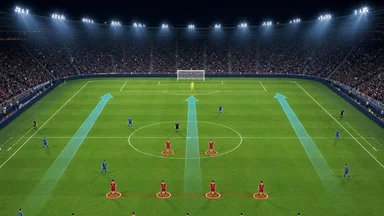
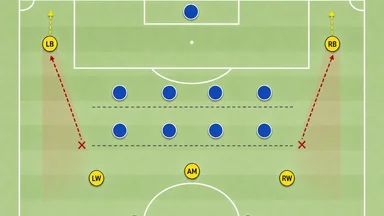
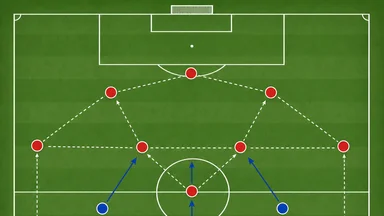
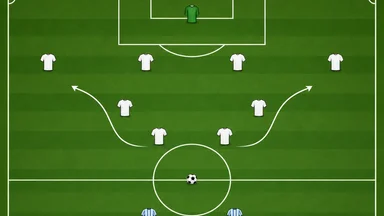
Roberto Martinez has always favored possession-based football, but his Portugal side has evolved since he took over in 2023. Early on, he relied on the 4-3-3 used by his predecessor Fernando Santos, but he gradually shifted to a 3-4-3 that better suits the current squad. In this system, Inacio is the ideal left-sided center-back because he can split between the goalkeeper and the left center-back, creating a numerical advantage in the first phase of build-up.
Against high presses, Inacio often drops between the goalkeeper and the midfield, forming a temporary back three with the goalkeeper effectively acting as a fourth defender. This allows Portugal to play through the press rather than bypass it. In the 2025 Nations League group stage match against France, Inacio completed 12 passes in his own defensive third, all under pressure, with a 100% success rate. His ability to receive on the half-turn and play forward is central to Martinez's philosophy.
The 3-4-3 also allows Inacio to push wide when the left wing-back advances, forming a back three that shifts across the pitch. This positional fluidity creates passing triangles that are hard for opponents to press. Martinez has drilled this relentlessly in training, and Inacio's familiarity with the system at Sporting means he adapts quickly. In qualifiers for the 2026 World Cup, Inacio started 8 of 10 matches, suggesting he is already the first-choice left center-back.
However, Martinez's system is not without critics. Some argue that his insistence on playing out from the back can become predictable and that Portugal lacks a Plan B when the press is effective—as seen in the 2022 World Cup quarterfinal against Morocco. Inacio's presence does not solve that problem by itself; it merely makes Plan A more efficient. If opponents sit deep and deny space for diagonals, Portugal may still struggle to break down a compact block.
Competition for minutes: Danilo, Antonio Silva, Vezo
Inacio is not guaranteed a starting spot. Danilo Pereira, now at Paris Saint-Germain, offers experience and physicality, though he is right-footed and less comfortable in build-up. Antonio Silva, the young Benfica defender, is highly rated but also right-footed. Martinez has experimented with a left-footed option from the second tier—Ruben Vezo, who plays for Levante—but Vezo lacks top-level minutes and has not been capped since 2020.
The most direct competitor is Danilo, who can play both as a defensive midfielder and center-back. His versatility makes him valuable, but his lack of a left foot means he cannot replicate Inacio's passing angles. When Danilo starts on the left side of a back three, Portugal's build-up often slows down, as he must turn onto his right foot before passing. This was evident in the 2024 European Championship, where Portugal struggled to progress the ball against Georgia's press.
Antonio Silva is a more natural ball-player than Danilo but is still right-footed. He could theoretically play on the left side, but his passing patterns are biased toward the right. In a 2025 friendly against Spain, Silva started on the left and completed only 3 progressive passes in the first half, compared to Inacio's 7 in the second half after he came on. The difference was noticeable: Portugal's attacks became more varied and dangerous.
Given Inacio's strong performances in qualifying, he is likely the starter if fit. But Martinez may rotate in group-stage matches to manage fitness, especially if Portugal qualifies early. The depth is thin, however, and an injury to Inacio would force Martinez to either play a right-footer out of position or call up an uncapped left-footed option—a risk the coaching staff is aware of.
What a breakout tournament looks like for Inacio
If Inacio starts and performs to his potential, a breakout World Cup could involve several key contributions. The most visible would be a decisive assist from a left-sided diagonal—perhaps against a Group H opponent that sits deep, allowing Inacio to pick out a runner on the right. A clean-sheet run in the knockout phase would also elevate his reputation, especially if Portugal faces a high-pressing team like Argentina or France.
Comparisons to Pepe's emergence in 2006 are tempting but premature. Pepe was already at Porto and had Champions League experience, while Inacio is still at Sporting and has not faced the same level of competition. Still, a strong tournament could secure him a move to a Premier League club—several scouts from top English sides have been tracking him, though no specific source is cited. A World Cup would be the perfect showcase.
More importantly, Inacio's presence could change Portugal's tactical identity. Instead of relying on individual brilliance from Fernandes or Leao, Portugal could become a team that systematically destabilizes opponents through passing patterns. That would be a significant evolution from the counter-attacking side that won Euro 2016, and it would give Martinez a distinctive style that endures beyond any single player.
Ultimately, Inacio's role at the 2026 World Cup will depend on how well he handles the pressure and whether his defensive weaknesses are exposed. The evidence from qualifying suggests he can perform at a high level, but the tournament stage is a different environment. If he succeeds, Portugal will have gained a valuable tactical tool; if he falters, the search for a left-footed solution will continue, but the team will have learned from the experience.