Lucas Gourna-Douath’s Salzburg Game Time Frames France 2026 Midfield
When France's squad for the 2026 World Cup is announced, one name that might cause discussion is Lucas Gourna-Douath. The 22-year-old midfielder has accumulated over 2,100 minutes at RB Salzburg in the 2024-25 season alone. That's not a trivial figure for a player many outside Austria have barely heard of. But within the context of Didier Deschamps' squad-building habits, Gourna-Douath fits a familiar pattern: an unheralded defensive midfielder who offers tactical balance at the highest level.
Salzburg's production line of midfield talent is well-documented. Before Gourna-Douath, the club developed Naby Keita, Dominik Szoboszlai, and even Erling Haaland—though the latter's trajectory was more about goals than midfield control. The club's 4-3-1-2 system demands that the deepest midfielder cover for advancing full-backs and screen the backline. Gourna-Douath has made that role his own, averaging 3.2 tackles and 1.8 interceptions per 90 minutes in the 2024-25 Austrian Bundesliga, while completing over 89% of his passes in the defensive third.
France's midfield for 2026 is already stacked. Aurelien Tchouameni and Eduardo Camavinga are locks if healthy, and Warren Zaire-Emery offers attacking thrust from deep. Youssouf Fofana brings experience from Monaco and AC Milan, while Khephren Thuram provides a box-to-box alternative. But none of them replicate Gourna-Douath's specific profile: a pure destroyer with the ability to break lines with vertical passes into forwards. That distinction matters, especially when Deschamps has historically favored a defensive balance in midfield—think back to the 2018 World Cup when N'Golo Kante and Paul Pogba formed the pivot, or the 2022 final when Tchouameni and Adrien Rabiot started.
Why Gourna-Douath's Salzburg Minutes Matter for France's 2026 Puzzle
The volume of minutes Gourna-Douath has accumulated at a Champions League-level club is the first reason to take him seriously. Over 2,100 minutes in 2024-25 means he started roughly 25 matches across all competitions, including appearances in the Champions League group stage. That's not a fringe player; it's a regular starter. For a national team manager like Deschamps, who values match rhythm and tactical discipline, a player who has been performing week in, week out in a high-intensity system is more appealing than one sitting on a top-tier bench.
Salzburg's tactical setup under Gerhard Struber (and previously under Matthias Jaissle) places a premium on the No. 6 role. The full-backs push high, the wingers tuck inside, and the midfield pivot is left exposed to counter-attacks. Gourna-Douath's job is to read those transitions, shut off passing lanes, and recycle possession quickly. His heat maps show a concentrated zone in front of the center-backs, similar to Tchouameni's positioning during France's 2022 World Cup run. That familiarity with a disciplined defensive shape could ease his integration into Deschamps' system.
Gourna-Douath is not just a destroyer. His pass completion rate in the final third sits around 78%, but more telling is his willingness to play vertical balls into the feet of forwards. In Salzburg's system, that means connecting with the two strikers or the No. 10 behind them. For France, that could mean feeding Kylian Mbappe or Randal Kolo Muani on the break. That progressive passing element—averaging 4.1 passes into the final third per 90—separates him from a purely destructive option like Boubacar Kamara, who is more conservative.
There is also the matter of France's schedule. The 2026 World Cup takes place in June-July, meaning the season just ended. Gourna-Douath will have a full 2025-26 campaign under his belt, including a Champions League group stage where he can test himself against elite opponents. If he performs well in those high-stakes matches, Deschamps will have a live data point to evaluate, not just scouting reports from the Austrian Bundesliga.
The Tactical Niche: Screening the Defense in a High-Press System
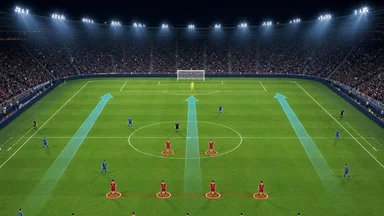
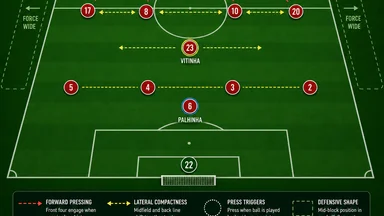
Salzburg's 4-3-1-2 formation is a demanding shape for a defensive midfielder. The full-backs—often players like Amar Dedic or Andreas Ulmer—push high to provide width, leaving the central defenders exposed. Gourna-Douath's primary job is to drop into the space between the center-backs when the full-backs advance, effectively becoming a third central defender in possession. That requires exceptional positional awareness and the ability to read danger early.
Statistically, Gourna-Douath's defensive output is impressive. On March 10, 2025, against Sturm Graz, he recorded 4 tackles, 2 interceptions, and 3 clearances in a 2-1 victory, illustrating his ability to disrupt attacks. Over the season, he averages 3.2 tackles and 1.8 interceptions per 90 minutes in league play, placing him among the top defensive midfielders in the Austrian Bundesliga. He recovers possession roughly 8 times per 90, often in dangerous areas near the halfway line. That ability to win the ball and immediately set up a counter-attack is precisely what Deschamps looks for in a midfield anchor.
His passing in the defensive third is notably safe—over 89% completion—but he also attempts longer passes when the opportunity arises. Roughly 15% of his passes travel more than 30 meters, and his accuracy on those is around 65%. That's not elite, but it's functional. The key is that he rarely forces the ball into trouble; his decision-making under pressure has improved noticeably since his early days at Saint-Etienne.
Comparisons to Tchouameni are inevitable, but they reveal differences. Tchouameni is more comfortable carrying the ball forward and has a wider passing range. Gourna-Douath is more static, preferring to stay deep and break up play. That makes him a more specialized option—one suited to protecting a lead or facing a dominant opponent. In a tournament setting, where game states vary, having a pure defensive midfielder on the bench could be valuable.
Developmental Arc: From Saint-Étienne to Salzburg to … France Squad?
Gourna-Douath's career path has been steady rather than meteoric. He debuted for Saint-Etienne at 17 in Ligue 1, making 23 appearances before the club's financial troubles forced a sale. RB Salzburg paid roughly €13 million for him in 2022, a significant fee for a teenager. The move was part of Salzburg's strategy of acquiring young talent, developing them, and selling at a profit. But Gourna-Douath's development has been slower than some predecessors.
In 2023-24, he was loaned to Roma in Serie A, where he made 18 appearances, mostly as a substitute. That experience exposed him to a different tactical environment—Jose Mourinho's pragmatic approach—and he learned to adapt to a lower-block system. Upon returning to Salzburg in 2024, he became a regular starter under Struber, playing in both the Austrian Bundesliga and the Champions League. That progression—from Ligue 1 to Serie A to the Champions League—has broadened his tactical understanding.
On the international stage, Gourna-Douath has 12 caps for France's U-21 side, where he has often partnered with younger midfielders like Desire Doue or Enzo Millot. He has not yet received a senior call-up, but French media outlets such as L'Equipe and RMC Sport have reported since early 2025 that Deschamps' scouting network has monitored him. The path from U-21 to senior team is well-trodden: Camavinga, Tchouameni, and Zaire-Emery all made the jump after U-21 performances. Gourna-Douath's chance may come in the 2025-26 international breaks, when Deschamps experiments with squad depth ahead of the World Cup.
One potential obstacle is the competition from other young midfielders. Khephren Thuram, for instance, has already earned senior caps and offers a more dynamic box-to-box style. But Thuram is not a dedicated defensive midfielder; he is more of a shuttler. Gourna-Douath's niche is clearer, and Deschamps has shown he values specialists for specific roles—think of how he used N'Golo Kante as a pure ball-winner in 2018.
Competition for Spots: Who Stands Between Him and a Plane to North America?
France's midfield depth for 2026 is intimidating. Tchouameni and Camavinga are almost certainties if fit. Warren Zaire-Emery, still only 20, has already become a regular for Paris Saint-Germain and seems destined for the squad. That's three names, likely occupying three of the four or five midfield slots in a 23-man squad. Youssouf Fofana, with his experience at Monaco and AC Milan, adds a fourth option. Khephren Thuram, now at Juventus, offers a fifth. Where does Gourna-Douath fit?
Deschamps typically brings four or five midfielders to a World Cup. In 2022, he took Tchouameni, Rabiot, Fofana, Camavinga, and Veretout—five players. Veretout was the least-used, appearing only in the group stage. That pattern suggests Deschamps values having a dedicated defensive midfielder as insurance. Tchouameni is the starter, but if he gets injured or suspended, the backup would need to be a like-for-like replacement. Gourna-Douath fits that description better than Camavinga, who is more box-to-box, or Zaire-Emery, who is more attacking.
There is also the factor of club form. If Gourna-Douath has a strong 2025-26 Champions League campaign—say, reaching the knockout stages with Salzburg—that would elevate his profile. Meanwhile, Fofana and Thuram will be competing for minutes at their respective clubs. If either falls out of favor, Gourna-Douath could leapfrog them. The timing of the World Cup (mid-2026) means the season's final months will be decisive.
Deschamps has occasionally left established players at home. In 2022, he omitted Olivier Giroud from the initial squad (though he was later called up due to injury). In 2018, he left out Alexandre Lacazette and Anthony Martial. Reputation alone does not guarantee a spot; tactical fit and current form weigh heavily. Gourna-Douath's case is not strong enough to guarantee inclusion, but it is plausible enough to merit attention.
The Deschamps Precedent: Surprise Picks Who Delivered
Didier Deschamps has a track record of calling up relatively unknown players and trusting them in big moments. At Euro 2020, he included Eduardo Camavinga as a 17-year-old with only a handful of Ligue 1 appearances. Camavinga ended up playing a minor role, but the decision signaled Deschamps' willingness to bet on youth. More strikingly, Marcus Thuram made the 2018 World Cup squad with only four senior caps, largely because of his versatility as a forward. He did not play a minute in the tournament, but the selection was not ridiculed.
The most relevant example for Gourna-Douath might be Randal Kolo Muani in 2022. Kolo Muani had just 12 senior appearances for Eintracht Frankfurt when Deschamps called him up as a late replacement. He went on to play in the final and missed a golden chance in extra time. That story illustrates that Deschamps is not afraid to take a player based on a short but impressive run of form. Gourna-Douath's 2025-26 season could be his equivalent of Kolo Muani's 2022 start.
Another precedent is Youssouf Fofana, who was relatively unknown outside France when he made the 2022 squad. Fofana had been a regular for Monaco but lacked Champions League exposure. Deschamps trusted his domestic form, and Fofana performed adequately in limited minutes. Similarly, Gourna-Douath's consistent Bundesliga performances could outweigh his lack of senior caps.
Deschamps values three things: tactical discipline, recent form, and a clear role within the squad. Gourna-Douath checks the first and third boxes; the second depends on his 2025-26 season. If he maintains his current trajectory, he will be in the conversation.
What a 2026 Role Looks Like: Late-Game Anchor or Spot Starter?
If Gourna-Douath makes the squad, his role would likely be defined by game state. In group-stage matches where France is expected to dominate possession, he might not be needed. But in knockout games against top opponents—say, England or Brazil—Deschamps may want a pure defensive midfielder to protect a lead. Gourna-Douath could be introduced in the 70th minute to shore up the midfield, similar to how Tchouameni was used in 2022.
There is also the possibility of a spot start if Tchouameni is unavailable. In the 2022 World Cup, Tchouameni started every match except the group-stage dead rubber against Tunisia. If he were injured, Deschamps would likely turn to a like-for-like replacement rather than reshape the midfield. Gourna-Douath's experience as a lone No. 6 in Salzburg's system makes him a natural candidate, more so than Camavinga, who tends to drift forward.
His aerial ability is another asset. Gourna-Douath wins roughly 1.5 aerial duels per 90, a decent number for a midfielder. In knockout games, set pieces often decide tight matches, and having a tall, physical presence in midfield can help defensively. He also has shown a willingness to take yellow cards for tactical fouls—a pragmatic trait that Deschamps appreciates.
However, there are reasons for caution. Gourna-Douath has never played in a high-pressure international match. The step from the Austrian Bundesliga to a World Cup semifinal is enormous. His passing range is limited compared to Tchouameni, and he can be prone to losing possession when pressed in advanced areas. These weaknesses could be exposed against elite opposition. Deschamps would likely use him only in situations where his strengths—defensive solidity and positional discipline—are most needed.
Ultimately, Gourna-Douath's inclusion would be a low-risk, high-reward gamble. He would likely be the 23rd or 24th man on the squad, the last midfielder to make the cut. But if called upon, his specific profile could help France navigate a tight knockout match. For a manager who prizes balance and defensive stability, that might be enough.