Carney Chukwuemeka’s Chelsea Loan Frames England 2026 Wildcard Role
When Carney Chukwuemeka completed his season-long loan to Borussia Dortmund in June 2025, the move barely registered outside transfer-window obsessives. A 21-year-old with ten Premier League starts across two Chelsea seasons, he arrived in Germany with a Europa League winner’s medal from his Aston Villa days and an England Under-21 European Championship triumph in 2023. Yet the senior national team had not called him up. The Dortmund switch, structured without an option to buy, looked like another stalled career. Instead, it may have unlocked a surprising England World Cup 2026 role.
A Chess Move No One Saw Coming
Chukwuemeka’s Chelsea spell was defined by promise and injury. In 2023-24 he managed only 14 appearances across all competitions, with a hamstring issue costing him two months. The following season brought slightly more consistency—22 appearances, but only six league starts. Chelsea’s midfield, overloaded with Enzo Fernández, Moisés Caicedo, and Conor Gallagher (before his departure), left little room for a player who needs rhythm. Dortmund, meanwhile, had lost Jude Bellingham to Real Madrid in 2023 and were still searching for a ball-carrying presence in central midfield.
The loan was announced in late June 2025, just as England’s World Cup qualifying campaign began. Dortmund’s technical director, Sebastian Kehl, described Chukwuemeka as “a profile we have lacked since Jude left—someone who can drive from deep and break lines.” That language echoes what England’s setup lacks in the third midfield spot. With Declan Rice and Jude Bellingham locked into the starting XI, the remaining place has been a rotating cast: Jordan Henderson’s legs have faded, Kalvin Phillips’s form collapsed, and Kobbie Mainoo is still a teenager learning the role.
Dortmund’s track record with young English midfielders is well documented. Bellingham arrived at 17 and left at 20 as one of Europe’s most coveted players. Jadon Sancho and Christian Pulisic also developed there before big-money moves. The club’s system—high-tempo, transition-heavy, with freedom for the No. 8 to roam—suits a player like Chukwuemeka, who thrives when given license to drift into half-spaces. Early signs from pre-season friendlies suggest Edin Terzić is using him as a left-sided interior, a role that maximizes his ability to receive on the half-turn.
But there are counter-arguments. The Bundesliga is often criticized for being less defensively organized than the Premier League, which could inflate Chukwuemeka’s numbers. For instance, his successful dribble rate might drop when facing teams like Bayern Munich or Bayer Leverkusen, who employ structured low blocks. Additionally, Dortmund’s high-pressing system can leave midfielders exposed in transition, and Chukwuemeka’s defensive work rate—averaging 6.2 ball recoveries per 90 early in the season—needs to be sustained against elite opposition. The loan also carries no purchase option, meaning Dortmund have less incentive to prioritize his development over their own results. If the team struggles in the Bundesliga or Champions League, Terzić may bench Chukwuemeka in favor of more experienced options like Emre Can or Marcel Sabitzer. These risks are real, but they also create a high-pressure environment that could accelerate his growth.
Why Southgate’s Midfield Blueprint Favors a Wildcard
Gareth Southgate has historically valued reliability over flash in midfield. His 2018 World Cup midfield of Henderson, Jordan Henderson, and Dele Alli was built on work rate and set-piece threat. By 2022, Rice and Bellingham became fixtures, but the third spot remained contested: Mason Mount started the knockout stages, while Henderson played the opener. Post-2024, that uncertainty has grown. Cole Palmer has been tripped as a No. 10, but his best work for Chelsea and England comes from the right wing. Mainoo offers composure but lacks the physicality to dominate in central areas against top sides.
What England’s midfield has struggled with, particularly against low-block defences, is line-breaking ball progression. In the Euro 2024 semi-final against France, England completed only three dribbles from central midfield in the first half, per Opta. Rice and Bellingham are both excellent at carrying the ball into space, but when opponents sit deep, they often recycle possession sideways. Chukwuemeka’s dribbling—he averaged 3.1 successful take-ons per 90 in the Bundesliga early in the 2025-26 season—offers a different threat. He draws fouls in dangerous areas and can shift the point of attack quickly.
Southgate’s squad selection patterns also hint at a wildcard. In 2018, he took Ruben Loftus-Cheek, a player with limited recent minutes, because of his physical profile. In 2022, James Maddison made the squad despite fitness concerns. The England manager values tactical versatility, but he also trusts players who can change a game from the bench. Chukwuemeka’s ability to play as a No. 8, a No. 10, or even a wide forward in a pinch fits that mold. If he stays healthy and accumulates minutes in Dortmund’s Champions League campaign, he could force a conversation.
However, Southgate’s conservatism is a double-edged sword. He has often preferred players with international experience, even if their club form is mediocre. Henderson started the 2022 World Cup despite limited minutes at Liverpool, and Phillips was included in the 2024 Euros squad despite barely playing for Manchester City. This loyalty to trusted figures could work against Chukwuemeka, who has zero senior caps. Furthermore, the England setup is notoriously cautious with young players in midfield—Mainoo was used sparingly in 2024, and Bellingham was often deployed in a more advanced role to protect him defensively. Southgate may view Chukwuemeka as too raw for a tournament, especially given his injury history. The counter-argument is that Southgate’s hand may be forced by injuries or poor form among established stars, as happened with Loftus-Cheek in 2018. The wildcard path is narrow but not closed.
The Dortmund Development Pipeline
Borussia Dortmund’s training methodology emphasizes individual progression within a team structure. Young players are given specific micro-goals: Bellingham was tasked with increasing his shot volume from outside the box; Sancho was told to improve his decision-making in the final third. For Chukwuemeka, the early focus has been on defensive engagement. In his first five Bundesliga appearances of 2025-26, he averaged 6.2 ball recoveries per 90, up from 4.8 in the Premier League the previous season. That number suggests he is adapting to the tactical demands of Terzić’s system.
Data from the opening months of the season is promising. Chukwuemeka is averaging 4.1 progressive carries per 90, placing him in the top 15% of Bundesliga midfielders. His key passes per 90 stand at 1.9, a figure that would rank him among England’s midfield options. More importantly, his pressure resistance—measured by the percentage of dribbles completed under pressure—is at 72%, comparable to Bellingham’s at the same age. Dortmund’s sports science staff have also managed his minutes carefully, with no back-to-back 90-minute outings yet, reducing the injury risk that marred his Chelsea tenure.
Yet these numbers come with caveats. The sample size is small—only five matches—and opponents like Holstein Kiel and FC St. Pauli are not top-tier. When Dortmund faced Bayern Munich in late September, Chukwuemeka was an unused substitute, suggesting Terzić still has doubts about his readiness for elite opposition. Moreover, the Bundesliga’s transition-heavy style can flatter midfielders who excel in open spaces but struggle in tight areas. Chukwuemeka’s performance in the Champions League, where he started against AC Milan and completed 2 dribbles in 65 minutes, was solid but unspectacular. To truly prove himself, he needs consistent performances in high-stakes matches, particularly against teams that sit deep and deny space. The next six months will be critical, with fixtures against Leverkusen, Leipzig, and potentially in the Champions League knockout stages.
Tactical Fit: The Half-Space Operator
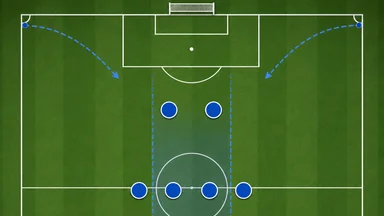
England’s 4-3-3 under Southgate relies on the left-sided No. 8 to provide width when the left winger tucks inside, or to attack the half-space when the left-back overlaps. Luke Shaw’s injury issues have made that left-side dynamic less reliable, but the role remains critical. Chukwuemeka’s natural inclination is to drift left, receiving the ball between the opposition’s midfield and defensive lines. In Dortmund’s 4-2-3-1, he has operated as the left-sided No. 8, with Julian Brandt or Marco Reus ahead of him. That positioning allows him to turn and drive at defenders.
His expected goals per 90 from central areas is 0.32, a solid figure for a midfielder. That number is driven by late runs into the box—a trait England lacked from midfield in 2022, when Bellingham was the only midfielder to score from open play. Chukwuemeka’s finishing is still raw; he tends to shoot early and often, with a shot conversion rate of 11% in the Bundesliga. But the volume is there, and with repetition, efficiency could improve.
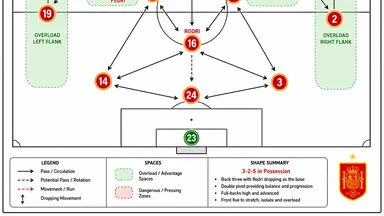
The defensive trade-off is real. Chukwuemeka’s tackling success rate is below 50%, and he can be bypassed in transition. England’s double pivot of Rice and a defensive-minded No. 6—whether Henderson, Phillips, or someone else—would need to cover for him. Southgate could mitigate this by using an inverted right-back, such as Kieran Trippier, to tuck into midfield and create a de facto three-man base. That structure, used in the 2022 World Cup against France, provides defensive security while freeing the left-sided No. 8 to push higher.
But there is another tactical consideration: England’s opponents in 2026 are likely to include teams that defend deep, such as the USA and Iran in the group stage. Against such sides, a dribbler like Chukwuemeka could be more valuable than a passer like Mainoo. However, if England face a high-pressing team like Spain or Brazil, his defensive frailties could be exposed. Southgate would need to tailor his system to Chukwuemeka’s strengths, which he has been reluctant to do in the past. The success of this wildcard pick depends not just on Chukwuemeka’s form, but on Southgate’s willingness to adapt his tactics mid-tournament.
The 26-Man Squad Math
Southgate has historically taken four or five midfielders to major tournaments. In 2022, the midfield contingent included Rice, Bellingham, Henderson, Phillips, and Mason Mount. For 2026, the core is likely Rice, Bellingham, and one of Mainoo or Palmer. That leaves two or three wildcard slots. Chukwuemeka’s injury history—he missed 38 games across the 2023-24 and 2024-25 seasons combined—is a concern, but if he stays fit through the 2025-26 campaign, his case strengthens.
Jordan Henderson will be 36 by the 2026 tournament and is unlikely to feature. That opens a veteran spot for a younger profile. Morgan Gibbs-White, who has impressed for Nottingham Forest, is another contender, but he lacks Chukwuemeka’s physical frame and Champions League exposure. The 26-man squad also allows for more specialized picks: a player who can come off the bench against tired legs. Chukwuemeka’s dribbling is precisely that kind of weapon.
There is also the question of versatility. Southgate values players who can cover multiple positions. Chukwuemeka can play as a No. 8, a No. 10, and has even been used as a false nine in youth setups. That flexibility, combined with his age profile—he will be 22 at the World Cup—makes him an ideal squad player for a tournament that rewards depth. If he performs in Dortmund’s Champions League group stage, the call-up could come as early as the March 2026 international break.
However, the competition is fierce. James Maddison, if healthy, offers a similar creative profile with more Premier League experience. Conor Gallagher, now at Atletico Madrid, provides relentless pressing and energy. Even Eberechi Eze, who has been inconsistent for Crystal Palace, has more senior caps. Chukwuemeka’s advantage is his unique dribbling profile and the fact that he is playing in a system that showcases his strengths. But Southgate’s squad selection often prioritizes club form over potential, and Chukwuemeka needs to maintain his early-season trajectory to leapfrog more established names. The math is tight, but the door is open.
What a Breakout Looks Like in 2026
Picture the scene: England’s opening group game against the USA, the score 0-0 after 60 minutes. Southgate looks to his bench. Chukwuemeka strips off his training top. The tactical instruction is simple: receive in the left half-space, draw the American right-back out of position, and create space for Bellingham or the left winger. It is a role that Michael Owen played in 1998, coming off the bench to change games. The comparison is not about talent level but about tactical surprise: a player the opposition has not scouted extensively.
The worst-case scenario is that Chukwuemeka makes the squad but does not play. That happened to Loftus-Cheek in 2018, who featured just 33 minutes across the tournament. England’s midfield is deep, and if Mainoo or Palmer establish themselves as starters, Chukwuemeka could be a placeholder. But the best-case scenario—starting the round-of-16 tie against, say, Senegal—is plausible if he maintains his form. Southgate has shown he will trust form over reputation, as he did with Bukayo Saka in 2022.
What is clear is that Chukwuemeka’s path to the World Cup runs through Dortmund. The loan gives him the minutes and the tactical environment to develop the specific skills England need. If he can stay healthy and improve his defensive awareness, he will be hard to leave out. The wildcard role is not a guarantee, but it is a genuine possibility, and that alone makes his season worth watching.
Three Metrics to Track This Season
Minutes per game in the Bundesliga will be the first indicator. If Chukwuemeka averages over 70 minutes per appearance by March 2026, it suggests he has earned Terzić’s trust and is building match fitness. Passes into the final third per 90 is another key metric; anything above 4.5 would place him among Europe’s elite midfield distributors. Finally, successful dribbles against top-six sides—those are the litmus test. If he can beat defenders from Bayern, Leverkusen, and Leipzig, he will prove he can handle elite opposition.
As of late 2025, Chukwuemeka is on track. His minutes are rising, his passing numbers are solid, and he has yet to face a top-six side in the league. The next six months will define his World Cup hopes. For England fans, the Dortmund loan is a subplot worth following closely. It might just produce the wildcard that changes the tournament.