Visa Tiers and Time-Zone Jumps Shape 2026 Fan Travel Plans
The 2026 FIFA World Cup will be the first edition hosted by three nations: the United States, Canada, and Mexico. For fans planning to follow their team across multiple venues, the tournament presents a logistical puzzle that goes far beyond booking flights and hotels. Visa requirements, time-zone jumps, and regional transport differences will shape how supporters move between cities. This article breaks down the key factors that fans should consider before mapping out their 2026 itinerary.
Three countries, three visa regimes, one trip
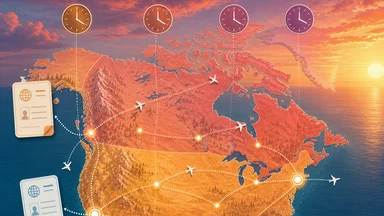
The US, Canada, and Mexico each maintain separate entry rules, and fans crossing borders will need to navigate a patchwork of permits. The US Visa Waiver Program covers citizens of roughly 40 countries, allowing stays up to 90 days without a visa, but travelers must obtain an ESTA authorization online before departure. Canada requires an eTA (electronic Travel Authorization) for visa-exempt nationals, which costs around 7 CAD and is valid for up to five years or until the passport expires. Mexico grants a visitor permit (Forma Migratoria Múltiple) to many nationalities upon arrival, often free of charge, but the length of stay varies.
For fans from countries not covered by these programs, the process becomes more involved. A US visa interview wait time can stretch several months in some consulates, while Canadian visitor visas and Mexican consular visas each have their own application procedures. The key complication is that a visa for one country does not grant entry to the others. A fan flying from Europe to New York, then driving to Montreal, then flying to Mexico City would need to satisfy three separate entry requirements.
Multiple-entry visas are essential for anyone planning to leave and re-enter a host country—for example, a fan based in the US who takes a day trip to Vancouver for a match. The ESTA and eTA both permit multiple entries within their validity period, but the ESTA typically lasts two years, while the eTA lasts five. Fans should check expiry dates carefully, especially if they hold passports that expire soon, as authorization is tied to passport validity.
Some tour operators, such as Sports Traveler and Roadtrips, are bundling visa advisory services with match ticket packages. For example, Roadtrips offers a "World Cup Concierge" package that includes visa guidance for multi-country itineraries, along with accommodation and transport. Independent travelers will need to research each country's official immigration website. The US Department of State, Immigration, Refugees and Citizenship Canada, and Mexico's Instituto Nacional de Migración all publish updated guidelines. It is prudent to apply for any required authorizations at least three to six months before departure.
Time-zone math forces hard choices on sleep
The three host countries span six time zones, from Newfoundland Standard Time (UTC-3:30) in eastern Canada to Hawaii-Aleutian Standard Time (UTC-10) in the US, though the main tournament venues cluster in four zones: Eastern, Central, Mountain, and Pacific. For European fans, the time difference ranges from 4 to 9 hours behind. A match kicking off at 11 a.m. in Mexico City (Central Time) would air at 6 p.m. in London, but a 7 p.m. match in Vancouver (Pacific Time) would start at 3 a.m. in the UK.
This creates a real challenge for fans traveling between venues. Flying from Toronto (Eastern) to Vancouver (Pacific) means losing three hours—a flight that departs at 8 a.m. local arrives at 10 a.m. local, but the traveler's body clock feels like 1 p.m. Jetlag researchers generally estimate that it takes about one day per hour of time-zone change to fully adjust. A fan hopping from New York to Los Angeles to Mexico City might face a cumulative shift of 5–6 hours over a week, potentially costing 2–3 days of suboptimal sleep and alertness.
Some supporters are planning to arrive a week early at their first host city to acclimatize, then treat subsequent moves as shorter adjustments. Others are choosing to base themselves in one time zone and fly out only for match days, accepting the travel fatigue. The tournament schedule, once released, will allow fans to see which kickoff times align with their preferred viewing windows—but for those attending live, the body clock will dictate the experience as much as the scoreline.
West Coast venues like Los Angeles and Vancouver may be more attractive to fans from Asia and Oceania, where the time difference is smaller. For instance, a 7 p.m. match in LA starts at 11 a.m. the next day in Tokyo, which is manageable for a live broadcast but not for travel. Conversely, East Coast cities like New York and Boston are easier for European audiences, but harder for those coming from the Pacific Rim.
Flight routes cluster around three hubs
Air travel between the 16 host cities will rely heavily on a few major connecting points. Dallas/Fort Worth (DFW), Los Angeles (LAX), and Mexico City (MEX) are the busiest gateways, each offering extensive domestic and international networks. Vancouver International (YVR) handles fewer long-haul routes than LAX—roughly 40% fewer by some estimates—so fans flying from Europe or Asia to Vancouver may need to connect through a US hub, adding a customs stop.
Toronto Pearson (YYZ) is well-connected from Europe, with direct flights from London, Frankfurt, Paris, and other major cities. Montreal (YUL) and Vancouver also have good European links, but less frequency. For fans planning to visit multiple countries, the most efficient route might be to enter through one hub and use a combination of flights and ground transport to move between venues.
Budget carriers are limited within North America compared to Europe or Asia. Airlines like Southwest, JetBlue, and WestJet offer competitive fares, but routes are not as dense as the Ryanair-EasyJet network. A round-trip flight from London to a single host city might cost in the range of $600–1,000 in economy, but a multi-city itinerary—London to New York, then to Mexico City, then to Vancouver, and back to London—could easily run $1,200–1,800 or more, depending on advance booking and season.
Charter flights are being organized by some travel agencies, particularly for groups following a single national team. These can simplify logistics but often come at a premium. Fans should book flights as early as possible, ideally when the match schedule is released, to secure reasonable fares. Flexible dates and willingness to fly on less popular days (Tuesday, Wednesday) can also save money.
Accommodation price surges follow stadium clusters
Hotel prices near stadium venues are expected to spike dramatically during the tournament. Based on pricing patterns from previous World Cups and major events like the Super Bowl, rates in host cities can triple or more. Near SoFi Stadium in Los Angeles, for example, some hotels were already testing rates three times normal levels during test events in 2024. Mexico City's median Airbnb price hit roughly $280 per night in 2026 simulation studies, compared to a typical $80–100.
Vancouver downtown hotel rooms were reportedly booked 18 months out by corporate clients and tour operators, leaving limited availability for individual fans. Shared housing platforms like Airbnb and Vrbo have seen traffic spikes of 200% or more during previous tournaments, and similar surges are expected. Some platforms have added a "World Cup Ready" filter to help fans identify properties with flexible cancellation policies and proximity to stadiums.
FIFA's official hospitality packages include accommodation, but prices start from around $950 per match for premium categories, which is out of reach for many. Independent fans are turning to alternatives like hostels, university dormitories (sometimes converted during events), and home exchanges. Some cities are planning to expand temporary camping sites or fan villages, though details remain sparse.
Not all host cities will see equal price inflation. Smaller markets like Guadalajara or Monterrey may have more moderate increases, while major destinations like New York, Los Angeles, and Cancun (if it hosts) will likely be most expensive. Fans willing to stay further from stadiums and use public transport can find more affordable options, but should factor in travel time and cost.
Ground transport gaps force rental-car reliance
Cross-border ground travel between host countries is less seamless than many fans expect. Amtrak, the US passenger rail service, has limited international routes: only the Cascades line from Seattle to Vancouver and the Maple Leaf from New York to Toronto run cross-border. Greyhound bus routes have been cut roughly 30% since 2020, reducing options between US cities. Mexico's intercity bus network is extensive and reliable, with companies like ETN and ADO offering comfortable service, but travel times are long—Mexico City to Guadalajara takes about 6 hours by bus.
Canada's Via Rail connects major cities in a corridor from Quebec City to Windsor, but service is infrequent and often delayed. For fans wanting to travel from Toronto to Vancouver, the train takes about 4 days, making flying the only practical option. Rental cars are likely to be in high demand, with prices during the tournament expected to range from $80 to $150 per day, depending on location and vehicle type. One-way rentals across borders are possible but incur additional fees and paperwork.
Some companies, such as FlixBus and Wanderu, are offering cross-border bus charters specifically for World Cup fans, bundling transport between host cities with match tickets. For example, FlixBus has announced a "World Cup Express" route connecting Los Angeles, Phoenix, and Dallas, with stops at stadium venues. These packages may simplify logistics but limit flexibility. Independent travelers will need to weigh time, cost, and convenience when choosing between flying, driving, or taking the bus. For shorter distances—say, between San Diego and Los Angeles—driving may be faster than flying when airport security and transit time are considered.
Driving across the US-Mexico border can involve significant wait times, especially at busy crossings like San Ysidro. A passport or visa is required, and rental car companies may restrict cross-border travel. Fans should check their rental agreement carefully.
Fan villages and mobile passes ease multi-city chaos
FIFA has announced plans for official Fan Zones in each host city, offering large-screen broadcasts, food, and entertainment. These zones will be free to enter and provide a gathering point for supporters without match tickets. Some cities are also exploring temporary fan villages with basic accommodation, similar to those used at the 2014 World Cup in Brazil, though no firm plans have been confirmed.
Mobile match pass bundles, which group three group-stage games in a single venue, are expected to be popular among fans wanting to minimize travel. These passes allow a supporter to stay in one city and watch multiple matches, reducing the need for inter-city movement. FIFA's ticketing platform will likely offer digital passes that can be stored on a smartphone, though resale rules and transferability will be important to understand.
Cross-border bus charter packages are emerging from tour operators, combining transport, accommodation, and match tickets for fans following a specific team. For example, a package might cover a fan's journey from New York to Philadelphia to Washington D.C. by bus, with hotels near each stadium. These can be cost-effective but often lack flexibility.
Travel insurance uptake is expected to double compared to a typical World Cup, given the complexity of multi-country itineraries. Policies that cover trip cancellation, medical evacuation, and lost luggage are advisable, especially for fans traveling with expensive camera equipment or medical needs. Some insurers, such as World Nomads and Allianz Travel, are offering specialized World Cup policies that include coverage for match ticket loss. For instance, World Nomads' "Event Protection" plan reimburses up to $2,000 for unused tickets if a match is cancelled or the fan is unable to attend due to covered reasons.
Data roaming and payment systems vary sharply
Staying connected across three countries requires some planning. US prepaid SIM cards with 15GB of data typically start at around $30 from carriers like T-Mobile or AT&T, but coverage in rural areas can be spotty. Canada's roaming fees can reach up to $15 per day for data, though some US carriers include Canada in their plans. Mexico remains a cash-heavy economy outside of tourist zones and major hotels, so fans should carry some pesos for small purchases, street food, and tips.
Tap-to-pay is widely accepted in the US and Canada, but less common in Mexico, where chip-and-PIN or cash are still the norm. Credit cards with no foreign transaction fees are recommended. eSIM providers like Airalo and Holafly have seen a 500% increase in pre-tournament sign-ups for multi-country data plans, allowing fans to switch between networks without physical SIM swaps. Downloading offline maps of each host city before departure is advisable, as data coverage in stadiums can be congested during matches. WhatsApp and other messaging apps are popular for coordinating meet-ups, but require an internet connection. Some fans plan to use a portable Wi-Fi hotspot, which can be rented at airports or purchased online.
Currency exchange rates will also affect budgets. The US dollar is strong against many currencies as of late 2024, but the Mexican peso has been volatile. Fans should monitor exchange rates and consider using a multi-currency travel card to lock in rates. ATMs are widely available, but withdrawal fees can add up.
Putting it all together: a forward-looking approach
Successfully navigating the 2026 World Cup's multi-country format requires advance planning across visas, time zones, transport, accommodation, and connectivity. Fans should start by mapping their desired itinerary and then tackling each layer: apply for visas and travel authorizations at least six months ahead, book flights and accommodation as soon as the match schedule is released, and research ground transport options between venues. Time-zone shifts can be mitigated by arriving early at each destination, and data roaming can be managed with eSIMs or multi-country plans. Travel insurance with comprehensive coverage is a wise investment given the complexity of the trip.
Looking ahead, the tournament may set a precedent for future multi-nation events, pushing host countries to streamline cross-border travel and harmonize entry requirements. For now, fans who treat logistics as part of the adventure will be best prepared to enjoy the matches. The 2026 World Cup promises to be a unique experience, blending the cultures of three nations into one soccer celebration—but only for those who plan carefully.